
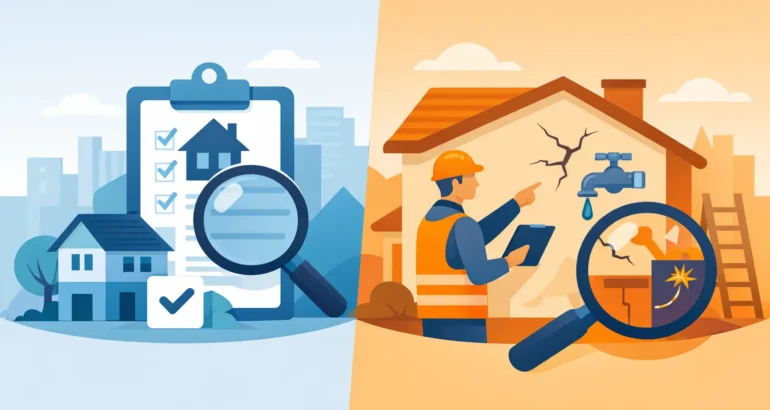
A HomeBuyer Report versus snagging comparison matters because these inspections answer two very different questions. One helps you assess the overall condition and risk of a property before purchase. The other identifies the defects, incomplete work and workmanship concerns a developer should put right. Choosing the wrong one can leave you with a report that is useful, but not designed for the issue in front of you.
For buyers of new-build homes across the Midlands and South Yorkshire, snagging is usually the more relevant first step. For an older house, a HomeBuyer Report is often the sensible starting point. There are situations where commissioning both provides the clearest protection.
What is a HomeBuyer Report?
A HomeBuyer Report, now commonly referred to within the RICS Home Survey framework as a Level 2 survey, is a visual inspection of a property in reasonable condition. It is designed to highlight significant defects, likely risks, urgent issues and matters that could affect your decision to proceed or the price you are prepared to pay.
The surveyor assesses accessible parts of the building, including the roof space where safe access is available, walls, floors, windows, drainage arrangements, visible signs of damp and the condition of key elements. The report uses a traffic-light style condition rating to show which issues need attention and which need monitoring.
It is a broad purchase-risk assessment rather than a detailed quality-control inspection. A HomeBuyer Report may identify cracking, dampness, roof defects, poor alterations, signs of movement or concerns around insulation. It will not normally catalogue every cosmetic imperfection, test every fitting or measure every finish against a new-build specification.
For properties with extensive alteration, age-related deterioration or obvious defects, a Level 3 building survey may be more appropriate. This provides a more detailed assessment and is often the better choice for an older, unusual or substantially renovated home.
What is a snagging inspection?
A snagging inspection is a detailed, evidence-led assessment of a new-build property’s finish, workmanship and visible condition. Its purpose is to identify defects that should be corrected by the developer or contractor, ideally before legal completion or before the end of the builder’s defect liability period.
A professional snagging survey looks beyond the obvious marks on paintwork. It considers whether components are fitted correctly, whether finishes are complete, whether visible work appears compliant with expected standards, and whether there are performance concerns that warrant remedial action.
Typical findings can include poorly aligned doors and windows, damaged glazing, incomplete sealant, uneven flooring, gaps around fittings, loose masonry, ineffective extraction, defective drainage falls, roof concerns, missing insulation and signs of heat loss. The exact scope depends on access, the stage of construction and the service selected.
A quality snagging report records findings clearly, usually with photographs, location references and practical descriptions. This gives the buyer a structured schedule to present to the developer, rather than relying on informal conversations or a short list created during a handover appointment.
HomeBuyer Report versus snagging: the key differences
The simplest distinction is that a HomeBuyer Report assesses the condition and risk of a property purchase, while snagging assesses the quality and completion of a newly built home.
A HomeBuyer Report is most commonly used before exchange or completion on an existing property. It focuses on significant condition issues that may require repair, further investigation or renegotiation. It does not generally set out to identify every minor defect.
Snagging is tailored to newly constructed homes. It is more granular and focuses on what the builder has delivered. A well-finished new home should not be assumed to be defect-free simply because it is covered by a warranty or has passed through the developer’s own processes.
The practical differences are clear:
- Property type: HomeBuyer Reports suit conventional existing homes, while snagging inspections are designed for new-build properties.
- Purpose: A HomeBuyer Report supports an informed buying decision; snagging supports remedial action by the developer.
- Detail: Snagging records a greater number of workmanship and finishing defects, including items that may not materially affect a property’s market value.
- Timing: A HomeBuyer Report is normally arranged before purchase; snagging can be completed pre-completion, shortly after moving in, or as part of a two-year warranty inspection.
Neither report is a substitute for the other when both purchase risk and new-build quality need assessing.
When a HomeBuyer Report is the right choice
If you are buying a Victorian terrace, a 1970s detached house or a flat that has been converted from an older building, a HomeBuyer Report is often the practical choice. You need to understand the condition of the structure and major elements before committing to the purchase.
It can reveal concerns that are not apparent during a viewing, such as defective roof coverings, moisture-related problems, poor ventilation, signs of historic movement or unsuitable alterations. Where the findings are serious, you may seek further specialist advice, negotiate on price or reconsider the purchase.
A HomeBuyer Report can also be useful for a nearly new property that has been lived in for several years and is being sold on. However, if the home remains within its developer warranty period, a dedicated snagging or warranty inspection may still identify quality issues that a general purchase survey is not intended to record in depth.
When snagging is the stronger option
For a buyer purchasing directly from a developer, a professional snagging inspection is usually the stronger fit. New homes can contain a long list of defects, from minor finish issues to faults that affect drainage, ventilation, thermal performance and weather resistance.
The best time is often before completion, provided the developer grants access. A pre-completion inspection gives you the opportunity to identify issues before you take possession. If access is not available, a post-completion snagging survey should be arranged as soon as practical after moving in.
Do not be reassured solely by a developer’s handover inspection. Internal checks can be valuable, but they are not independent and may not examine the home with the same buyer-focused level of detail. An independent inspection provides documented evidence and a clear record of outstanding work.
New Homes Inspections carries out specialist new-build assessments with reporting focused on practical remedial outcomes. Findings should be raised with the developer promptly and kept on record, particularly where there are repeat defects or concerns that may become more difficult to resolve later.
Can you need both inspections?
Yes. This is most likely where a property is relatively new but no longer being sold by the developer, or where a buyer wants both a condition overview and a detailed assessment of workmanship.
For example, a three-year-old home may look modern and well maintained, but it could still have roof defects, inadequate drainage, cracking, poor sealing or signs of heat loss. A HomeBuyer Report can identify broader risks in the purchase. A focused new-build inspection can then provide a detailed schedule of defects that may have developed during the early life of the building.
It depends on the property, the available warranty cover, the concerns identified during viewing and your tolerance for risk. If the home is older, spend the budget on the most suitable level of building survey. If it is a fresh new-build purchase, prioritise snagging. If there is uncertainty around both condition and workmanship, ask for advice on the scope before booking.
What each inspection will not do
It is sensible to understand the boundaries of any survey. Neither a HomeBuyer Report nor a snagging inspection is usually a guarantee that every concealed fault has been found. Surveyors work from visible and safely accessible areas, and do not normally lift floors, remove finishes or dismantle components without a specific agreement.
A standard inspection also does not replace specialist testing where it is needed. Suspected roof defects may require a roof condition survey or drone inspection. Concerns about cold areas, insulation continuity or air leakage may benefit from thermal imaging or a heat loss survey. Electrical, gas and drainage systems may require testing by appropriately qualified specialists where visible evidence points to a concern.
This is not a weakness in the process. It is how professional inspection works: identify evidence, record it accurately and recommend further investigation where the risk justifies it.
How to choose with confidence
Start with the age and sale route of the property. A new home bought from a developer calls for snagging. An established home calls for a HomeBuyer Report or, where the building is older or more complex, a Level 3 survey.
Then consider timing. Before you are legally committed to an existing-home purchase, a HomeBuyer Report gives you information that may influence your decision. Before completion of a new-build home, snagging gives the developer the chance to address defects before handover. If you have already moved in, act early and keep all correspondence, photographs and repair records together.
Most importantly, choose an independent inspector with the right specialism for the property. Clear reports, photographic evidence and standards-based observations make it easier to have a productive conversation with a developer, seller or managing agent. The right inspection is not simply paperwork – it is a practical way to protect your investment and move forward with confidence.