
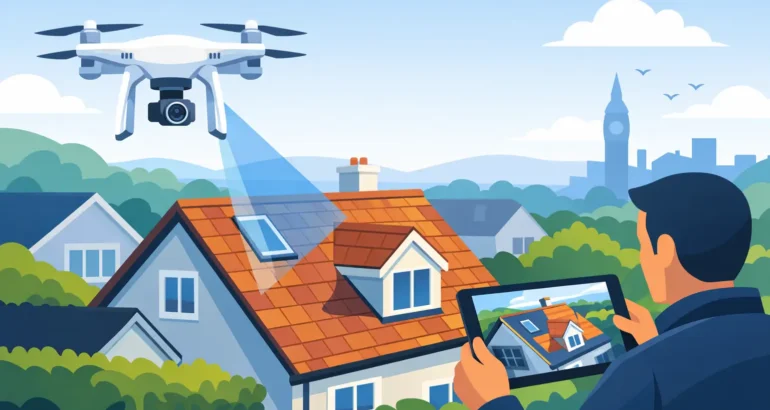
A roof can appear sound from the pavement while hiding slipped tiles, poorly formed flashings, blocked outlets or defects around chimneys and roof penetrations. This drone roof survey guide explains how a professionally managed aerial inspection helps homeowners obtain clear visual evidence without putting anyone on a ladder before it is necessary.
For new-build owners, the timing can be particularly valuable. Roof defects may not be apparent during a standard walk-around, yet they can lead to water ingress, staining, heat loss and avoidable disputes if they are not documented early. For established homes and commercial buildings, drone imaging can provide an efficient first assessment after storms, before a purchase, or when approaching the end of a builder or contractor warranty.
What a drone roof survey can reveal
A drone roof survey uses high-resolution aerial images and video to inspect roof areas that are difficult, unsafe or impractical to view from ground level. A competent surveyor assesses the recorded imagery alongside observations from around the property, identifying visible defects and areas that need closer investigation.
On a pitched roof, this may include cracked, slipped or missing tiles and slates; uneven roof lines; poorly seated ridge or hip tiles; damaged verge details; and gaps around abutments. The survey can also examine flashing to chimneys, dormers and valleys, which are common points for water to enter when materials are incomplete, poorly dressed or deteriorating.
Flat roofs benefit from aerial views too. Images may show ponding water, splits, open laps, failed edge trims, damaged coverings, blocked rainwater outlets or issues at parapet walls. On larger buildings, the drone can capture a broad overview of roof zones and drainage routes that would be difficult to assess consistently from a single access point.
The inspection can also record the condition of gutters, downpipes, fascias, soffits, rooflights, solar panels, chimney stacks and external vents. These elements matter because a defect is not always in the main roof covering. Water can enter through a failed flashing, overflowing gutter or poorly sealed penetration and then present internally some distance away.
When should you arrange a drone roof inspection?
The right time depends on the property and the concern. A drone survey is often arranged when there is evidence of a problem, but it is equally useful as a preventative inspection where access is restricted or the roof has not been reviewed for several years.
For a new-build home, consider a roof inspection as part of a snagging survey or post-completion inspection. A roof may have been exposed to weather throughout construction, while later trades can affect tiles, membranes, flashings and gutters. Clear evidence gives homeowners a stronger basis for requesting remedial works from the developer.
Owners nearing the end of a two-year builder warranty should also act before the deadline. Minor defects are easier to raise and resolve while the developer remains responsible for putting workmanship issues right. A documented roof condition survey can help distinguish a visible construction or installation concern from general maintenance requirements.
Aerial inspection is also sensible after high winds, heavy rainfall or falling branches. You may notice a damp patch, loose debris in the garden or an overflowing gutter but have no safe way to assess the roof itself. Rather than relying on assumptions, professional imagery provides a record of what is visible at that point in time.
For buyers, a drone survey can complement a home buyers survey where the roof is high, steep, obscured or otherwise inaccessible. It does not remove the need for a surveyor to assess the wider property, but it can improve the available evidence about a part of the building that often carries significant repair costs.
How a professional drone roof survey is carried out
A proper inspection begins before the drone leaves the ground. The surveyor considers the building layout, access, surrounding obstacles, weather conditions and the purpose of the survey. Safe operation matters as much as image quality, particularly in built-up areas where neighbouring homes, trees, roads and overhead services may affect flight planning.
The surveyor then captures images from suitable angles to show the roof covering, junctions and details clearly. Close images are useful for suspected defects, while wider shots establish location and context. If a concern is identified, the report should make it clear where it is, what is visible and why further action may be appropriate.
Weather can affect both the flight and the findings. Rain, strong winds, low light and wet surfaces can limit safe operation or obscure fine detail. A responsible operator may postpone the inspection rather than produce poor-quality evidence. That is a worthwhile trade-off when the survey is intended to support a developer query, insurance matter or repair quotation.
Professional drone use also requires appropriate competence, permissions and insurance arrangements. Homeowners should not assume that anyone with a drone is equipped to inspect a roof safely or interpret construction details accurately. The value comes from combining licensed drone capability with property surveying knowledge and an independent, evidence-led report.
What the report should give you
Images alone are helpful, but they rarely provide enough context to support a repair request. A useful roof survey report should translate observations into clear, practical findings.
It should identify the inspected areas, include labelled photographs, describe visible defects or risks, and state whether further investigation or repair is recommended. Where relevant, the report should distinguish between a confirmed visible issue and a limitation of the inspection. For example, a drone may show lifted tiles at a ridge, but it cannot always confirm the condition of the underlay, battens or concealed timbers beneath.
For new-build homeowners, this clarity is especially important when raising a snagging item. A vague statement such as “the roof does not look right” is easy to dismiss. A dated report with photographs, the location of the issue and a concise explanation of the concern gives the developer a defined item to inspect and rectify.
The report can also help when obtaining quotations. Contractors can review the images before attending, which may reduce uncertainty about access equipment and the likely scope of works. A physical inspection may still be required before repair, particularly where defects are hidden or where the roof structure needs testing.
What a drone survey cannot tell you
A drone roof inspection is highly effective for visible external defects, but it is not a substitute for every type of roof investigation. It cannot see behind a fascia, beneath a tile, inside a cavity or through a roof covering. It also cannot safely confirm structural strength simply from images.
If there are signs of active leaks, sagging, internal mould, damaged ceiling finishes or persistent condensation, further investigation may be needed. This could involve an internal inspection, moisture assessment, thermal imaging or targeted access by a qualified roofing contractor. The correct approach depends on the evidence and the building’s construction.
Similarly, a drone cannot make a poor repair good. Its role is to establish an informed starting point: what is visible, where concerns are located and whether closer examination is justified. That can prevent unnecessary work, but it can also reveal that a minor-looking issue needs prompt attention.
Preparing for a drone roof survey
You do not need to make extensive preparations, although access around the property is useful. Move vehicles where practical, keep pets indoors during the flight and tell the surveyor about known leaks, previous repairs or areas of concern. If you have photographs of an internal damp patch, share them, as they can help direct the external assessment.
For leasehold, managed or commercial properties, check whether site access, caretaker notification or permission from the managing agent is needed. The surveyor will also need to assess local operating conditions on arrival. Not every property can be flown on every day, and safety requirements always take priority over convenience.
New Homes Inspections combines drone imagery with independent property inspection experience, helping owners in the Midlands and South Yorkshire present roof concerns with credible evidence rather than guesswork.
A roof is one of the most expensive parts of a property to repair and one of the hardest for an owner to inspect safely. If a concern has been raised, a warranty deadline is approaching or the roof has simply not been properly viewed, an evidence-led drone survey can give you a clearer basis for the next decision.