
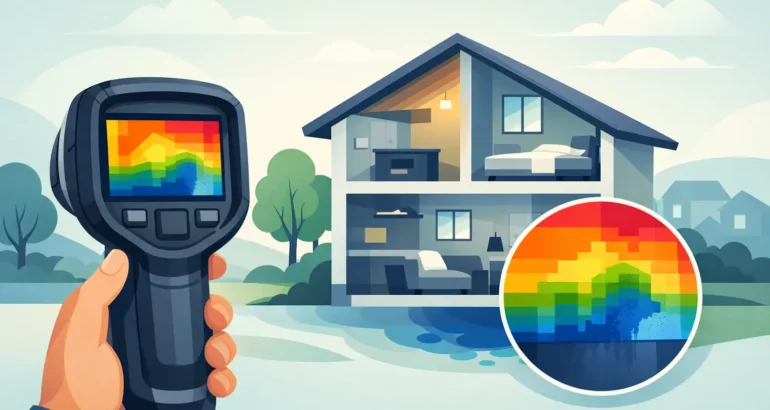
A dark patch behind a wardrobe, peeling paint around a window reveal or a musty smell in a new-build home can quickly raise concerns about damp. So, can thermal imaging find damp? It can identify temperature patterns that may be consistent with moisture, but it does not directly measure or prove damp on its own. Used correctly as part of an independent inspection, thermal imaging is a valuable way to focus further investigation and produce clearer evidence for a developer or warranty provider.
For new-build buyers, this distinction matters. A thermal image can reveal where a problem may be developing behind a finished surface, often before staining or mould becomes obvious. The underlying cause still needs to be established through inspection, moisture testing and an assessment of the building fabric.
Can thermal imaging find damp reliably?
Thermal imaging cameras detect infrared radiation and display surface temperature differences as a visual image. Areas that appear cooler than the surrounding wall, ceiling or floor may indicate moisture because evaporation can lower the surface temperature. This is why thermography can be helpful when investigating suspected leaks, water ingress, condensation risk and insulation defects.
However, a cool area is not automatically damp. It may be caused by missing or poorly fitted insulation, thermal bridging around lintels or wall junctions, air leakage, an unheated room beyond the wall, or simply a change in material. Equally, moisture may not always show as a clear cool pattern, particularly if environmental conditions are unsuitable or the affected area has begun to dry.
A professional surveyor treats a thermal image as evidence to interpret, not a stand-alone diagnosis. The image should be considered alongside visible defects, the property’s construction, recent weather, heating conditions, humidity readings and appropriate moisture measurements. This avoids presenting an assumption as a finding.
What damp can a thermal survey help to investigate?
In the right conditions, thermal imaging can be particularly useful for locating areas that warrant closer examination. In a new-build property, this may include a cold patch below a window, a ceiling area beneath a bathroom, damp-looking finishes around a patio door, or repeated mould growth in a corner.
Leaks from plumbing and sanitary fittings
A concealed leak from pipework, shower trays, baths or waste connections can create a localised temperature anomaly. A thermal camera may show a cooler pattern extending across a ceiling or wall, helping to identify the likely path of water without immediately removing finishes.
The surveyor will then look for supporting signs, such as staining, swollen skirting boards, movement in flooring, damaged sealant or elevated readings on a suitable moisture meter. Where a leak is suspected, prompt action is essential. Water damage can affect plasterboard, timber-based flooring, insulation and adjoining finishes long before a substantial mark appears.
Rainwater penetration and defective external details
Water ingress can occur around poorly sealed window and door frames, roof penetrations, cavity trays, brickwork junctions, flashing or defective gutters. Thermal imaging may reveal cooler areas after suitable weather conditions, especially where moisture has affected the internal face of an external wall.
It is not a substitute for inspecting the outside of the building. External examination remains essential, and drone roof inspection can be useful where rooflines, valleys, gutters or high-level details cannot be safely viewed from ground level. The objective is to trace the route of water, rather than merely record its internal effect.
Condensation and cold bridging
Not every damp-related issue is a leak. Condensation occurs when warm, moisture-laden indoor air meets a surface cold enough for water vapour to condense. Thermal imaging can identify cold surfaces and thermal bridges that increase this risk, such as poorly insulated reveals, gaps in insulation, concrete structural elements or junctions between walls and roofs.
This is especially relevant in new homes that are designed to be relatively airtight. Effective ventilation, correctly commissioned extract systems and appropriate heating use all play a part. If the fabric contains cold bridges or air leakage paths, however, household routines alone may not resolve the problem. A report should distinguish between an occupier-use issue and a construction or installation defect.
Defects affecting insulation and airtightness
A thermal survey may show patterns associated with missing insulation, poorly installed insulation or air movement through gaps in the building envelope. These findings can resemble moisture-related cooling, which is why careful interpretation is vital.
For example, a consistently cold vertical strip on an external wall may indicate an insulation void or structural thermal bridge rather than water ingress. It may still be a significant defect, affecting comfort, energy efficiency and condensation risk. The right remedy depends on the cause.
Why the survey conditions matter
Thermal imaging is most effective when there is a meaningful temperature difference between inside and outside, commonly known as a thermal gradient. During colder weather, with the home heated normally, defects in the external envelope are often easier to identify. Surveys carried out in mild conditions may still be useful for investigating a suspected leak, but they can be less conclusive for heat-loss and insulation concerns.
Recent sunshine can warm external surfaces and distort results. Heavy rain, wind, furniture placed tightly against walls, radiators, underfloor heating and recently used showers can also influence the image. A competent surveyor records relevant conditions and avoids over-interpreting patterns that may have a straightforward environmental explanation.
The camera itself matters, but the operator matters more. Thermal imaging is a diagnostic tool that requires training, building knowledge and a disciplined inspection method. Clear reporting should explain what was observed, what it may indicate, what limitations apply and what further action is recommended.
How damp is confirmed after a thermal anomaly is found
When thermography highlights a suspicious area, confirmation usually comes from a combination of non-invasive checks. The surveyor may take moisture readings, assess relative humidity and surface temperatures, inspect accessible voids and review the location against likely plumbing routes, external details and construction junctions.
Moisture meters have limitations too. Some meters are calibrated for timber and can provide comparative rather than definitive readings when used on plaster, masonry or plasterboard. That does not make them unhelpful, but it reinforces the need for more than one piece of evidence.
Where the risk is significant or the cause remains unclear, further investigation may be needed. This could involve a plumber carrying out pressure testing, a drainage specialist undertaking camera work, opening up a small area of finish, or monitoring conditions over time. For a new-build home, documented evidence is valuable when asking the developer to investigate and rectify a defect under its warranty obligations.
When should a new-build owner arrange an inspection?
Do not wait for mould to spread or decoration to fail. An inspection is sensible if you notice recurring staining, a persistent musty odour, cold and damp-feeling surfaces, mould in a particular location, warped flooring, ceiling marks below bathrooms, or water appearing around windows and doors after rain.
It can also be beneficial as part of a focused heat-loss survey where rooms feel noticeably colder, heating costs appear disproportionate, or condensation is forming around junctions. Near the end of the builder’s two-year warranty period, a thermal assessment can help identify defects that have become more apparent through seasonal use of the home.
New Homes Inspections uses evidence-led reporting to separate suspected moisture issues from insulation, airtightness and workmanship concerns. This gives homeowners a clearer basis for requesting remedial action, rather than relying on a photograph of a stain or a verbal reassurance that a problem is “normal”.
What to expect from a useful thermal imaging report
A helpful report should not simply contain colourful images. It should identify the inspected areas, explain the survey conditions, include visible-light photographs for comparison and set out what each thermal pattern may mean. It should also state where a finding is inconclusive and recommend proportionate next steps.
For example, a report may identify a cool area below a bedroom window, record elevated comparative moisture readings, note defective external sealant and recommend that the developer investigates the window installation and surrounding weatherproofing. That is far more actionable than saying a wall is cold.
If you suspect damp, treat thermal imaging as an intelligent first step rather than a final verdict. Combined with a thorough inspection and properly documented evidence, it can help protect your investment and give you confidence to pursue the right repair before a minor defect becomes a costly one.