
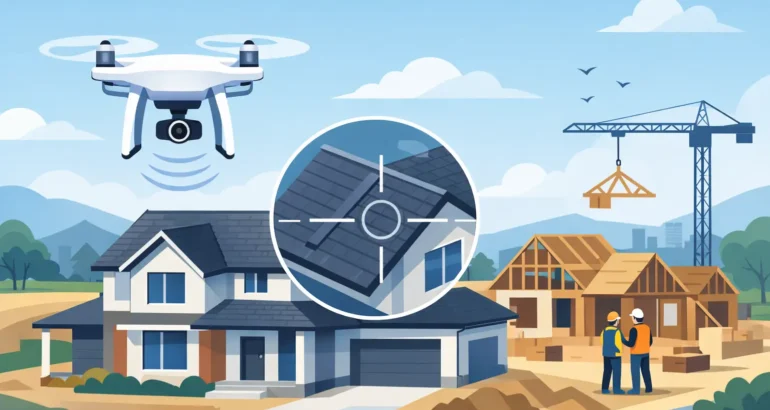
A roof can look acceptable from the driveway while concealed defects are already allowing water to track beneath tiles, flashings or roof coverings. A drone roof inspection provides independent, high-resolution evidence of areas that cannot be assessed safely or reliably from ground level, helping homeowners act before minor workmanship issues become expensive repairs.
For new-build buyers, this matters from the first months of ownership through to the end of the builder warranty period. For commercial owners and facilities teams, it offers a practical way to monitor roof condition without unnecessary access equipment or disruption. The objective is not simply to take aerial photographs. It is to assess visible condition, identify concerns in context and provide clear evidence for remedial action.
What a drone roof inspection can reveal
Roofs are exposed to wind, rain, ultraviolet light and seasonal temperature changes from the day a property is handed over. On a new-build home, defects are often linked to installation quality rather than age. Aerial imaging allows an inspector to review roof slopes, ridges, valleys, verges, flashings, gutters and drainage points in far greater detail than a visual check from the ground.
Common findings include slipped, cracked or poorly seated tiles; incomplete ridge detailing; uneven mortar bedding; damaged or misaligned flashing; open joints around roof penetrations; and gutters that do not fall correctly towards outlets. On flat roofs, drone imaging can help identify ponding water, lifted edges, damaged coverings and defects around parapets, outlets or rooflights.
The inspection can also reveal issues at interfaces, which are often where water ingress begins. Chimney flashings, dormers, soil vent pipes, satellite installations, solar panels and abutments all require careful detailing. A defect in one small area may affect ceilings, insulation, timber and internal finishes long before the cause becomes visible inside the property.
Why roof evidence matters on a new-build home
A developer may have completed internal snags and presentation items before handover, but the roof is rarely something a buyer can inspect closely. Scaffolding has been removed, access is restricted and a safe ladder inspection may still be inappropriate. This can leave the homeowner relying on assumptions about an area that is fundamental to the building envelope.
A professionally conducted drone roof inspection creates a dated visual record of the roof’s condition. Where defects are identified, the findings can be documented with clear images and an explanation of the likely concern. This gives homeowners a stronger basis for raising issues with the developer, builder or warranty provider.
It is particularly useful when a property has signs that may point to a roof-related defect, such as staining to upper-floor ceilings, damp patches in a loft, overflowing gutters, loose tiles after high winds or water entering around a dormer. It can also form part of a wider snagging survey, post-completion inspection or 2-year warranty inspection.
That said, aerial imaging does not replace every form of roof investigation. A drone cannot see through roof coverings, test the integrity of hidden underlay or assess concealed timber. If imagery suggests a significant defect, further investigation may be required. The value lies in identifying visible evidence and directing the next step proportionately.
Drone inspection versus conventional roof access
Traditional roof inspections may involve ladders, scaffold towers, cherry pickers or physical access to roof areas. These methods still have a place, particularly where close-contact testing, measurements or repairs are required. However, they can be costly, disruptive and subject to weather, site constraints and safe-access limitations.
Drone surveying is often the sensible first stage. It can capture detailed imagery of difficult-to-reach elevations, roof pitches and high-level features without putting an inspector on the roof unnecessarily. This is especially useful on steep roofs, properties with limited access, blocks of flats, commercial units and sites where working at height would otherwise require extensive planning.
The trade-off is that drone imagery is a visual inspection method. It provides strong evidence of externally visible defects, but it cannot confirm the condition of every concealed component. A competent inspection report should be clear about that boundary rather than claiming certainty where further access is needed.
What happens during a professional drone roof inspection
A proper inspection begins before the drone leaves the ground. The surveyor considers the property layout, airspace restrictions, weather conditions, nearby people and vehicles, overhead hazards and the areas requiring assessment. Flights must be undertaken safely, lawfully and with appropriate operational controls.
The drone is then used to capture targeted imagery of the roof and associated high-level elements. Rather than relying on random photographs, the inspection should cover the areas most likely to show defects: ridge lines, tile courses, hips, valleys, leadwork, gutter runs, roof penetrations and junctions with walls or neighbouring structures.
After the flight, images are reviewed as part of the inspection process. The resulting report should distinguish between observed defects, items requiring monitoring and areas where further investigation is recommended. It should use plain language, supported by photographs that make the location and nature of each issue clear.
At New Homes Inspections, drone capability supports an evidence-led approach to roof condition surveys and snagging inspections. Findings are assessed independently, with the focus on practical remedial outcomes rather than vague observations.
When should you arrange a drone roof inspection?
For a new-build property, the best timing depends on the reason for the inspection. Before legal completion, a drone survey can be valuable where access, timing and site conditions allow, particularly if it forms part of a wider pre-completion inspection. It can identify visible concerns before you take responsibility for the home.
After completion, an inspection is useful if you notice symptoms of water ingress or poor drainage, or if the roof has been exposed to severe weather. It is also well suited to a 2-year warranty inspection. Many workmanship issues become more apparent after the building has experienced a full cycle of rain, wind, frost and summer heat, yet homeowners still have an opportunity to seek repair from the builder.
For established homes and commercial buildings, periodic roof checks are a sensible part of planned maintenance. The right frequency depends on roof type, age, surrounding trees, previous repairs and the consequences of a failure. A flat roof with drainage concerns may warrant closer monitoring than a recently installed pitched roof with no signs of deterioration.
What to look for in the report
The quality of the report matters as much as the quality of the images. A collection of aerial photographs may be useful for reference, but it does not necessarily provide an inspection outcome. You need findings that can be understood by a developer, contractor, managing agent or warranty provider.
A useful report identifies the location of the issue, explains what is visible, sets out the likely risk and recommends a proportionate next action. It should avoid overstating what can be confirmed visually, while making clear when a defect needs prompt attention. Where relevant, it should also consider workmanship standards, roof drainage and the risk of water ingress.
Independence is equally important. An inspection carried out for the property owner gives you an objective record to support discussions about repairs. Clear, dated evidence can reduce the chance of a concern being dismissed as cosmetic, pre-existing or difficult to locate.
Is a drone roof inspection worth it?
It is most valuable where the roof is difficult to inspect, where there is a concern that needs documenting, or where early action could prevent wider damage. A missing tile is rarely just about one tile if rainwater is reaching the underlay or roof space. Similarly, a poorly formed valley or blocked outlet can create damage that is disproportionate to the visible defect.
Not every property needs a drone survey as a standalone service. If the roof is readily accessible and a close inspection is already planned, conventional access may be more appropriate. But where safety, height, cost or access are barriers, drone imagery offers a practical and evidence-based way to understand roof condition.
A roof defect is easier to resolve when it is identified early, recorded clearly and raised with the responsible party before small signs of failure turn into internal damage.