
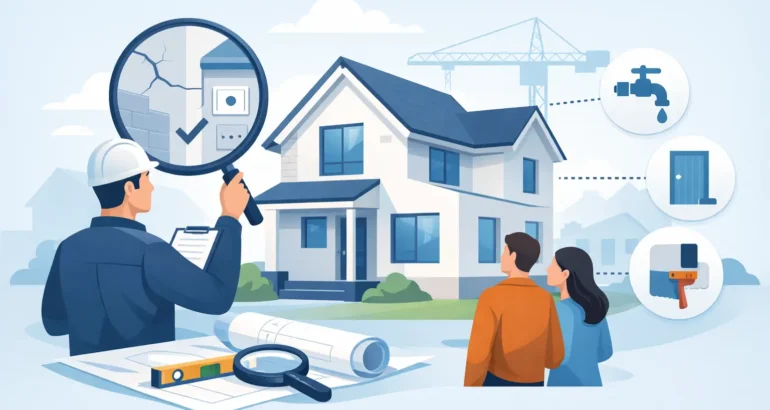
A new-build home can look finished on handover day while still containing defects behind neat paintwork, inside cupboards or above the ceiling line. So, what is a snagging survey? It is an independent, detailed inspection of a newly built property that identifies defects, incomplete work and workmanship issues for the developer to put right.
For buyers, it provides clear evidence of the property’s condition at a key point in the purchase. Rather than relying on a quick walk-through with the site team, you receive a professional report that records findings, explains why they matter and helps you pursue remedial work with confidence.
What a snagging survey checks
A snagging survey is designed specifically for new-build homes. The surveyor assesses the quality and condition of visible construction work, finishes and accessible building elements, looking for issues that fall below a reasonable standard of workmanship, appear incomplete or may affect the home’s performance.
Typical findings range from minor cosmetic snags, such as uneven sealant, chipped tiles, poorly fitted skirting boards and marked glazing, to more significant concerns. These can include defective brickwork, inadequate insulation, uneven floors, poorly operating doors and windows, roof defects, drainage concerns, missing fire-stopping or ventilation issues.
The inspection is not simply a list of cosmetic marks. A competent surveyor considers whether defects could affect weather resistance, thermal performance, durability, safety or compliance with relevant building standards and warranty expectations. This is why an independent inspection can carry more weight than a buyer’s own list of snags.
Why new-build homes need independent inspection
New homes are built quickly, often with several trades working across the same plot in a short period. Most developers have their own quality-control processes, but those processes do not remove the possibility of missed defects, rushed finishes or work that requires correction after handover.
A property may also be signed off for completion before every issue is obvious to a homeowner. For example, poor loft insulation may only become apparent when inspected, while roof defects can be difficult to identify from ground level. Thermal imaging, moisture assessment and drone roof inspection can provide further evidence where the property and conditions make those methods appropriate.
An independent surveyor works for you, not the developer. Their role is to assess the home objectively, document defects accurately and provide a report that can be shared with the developer’s customer-care team. That separation matters when you need a clear record rather than an informal assurance that an issue will be dealt with.
When should you arrange a snagging survey?
The best timing depends on the developer’s access policy and your completion date. A pre-completion snagging survey, often referred to as a pre-handover inspection, takes place before legal completion where access is permitted. It gives you the opportunity to raise issues before you move in and before final handover.
If pre-completion access is not available, a post-completion snagging survey is still highly valuable. It should be arranged as soon as practical after getting the keys, ideally before furniture, decorating and day-to-day use make defects harder to inspect or attribute.
A later inspection can also be useful. Many workmanship and performance issues only show themselves after the home has been occupied through changing weather conditions. A two-year warranty inspection, completed before the builder’s defect-liability period ends, can identify items that should be raised while the developer remains responsible for repairs.
There is no single deadline that suits every buyer. The practical priority is to record issues early, communicate them in writing and keep copies of all correspondence and repair commitments.
What happens during the inspection?
The surveyor begins with a systematic assessment of the external areas, including the roof where safely accessible or visible, brickwork, render, pointing, paths, driveways, drainage, boundary treatments, windows and doors. They then inspect the internal rooms, checking finishes, joinery, floors, walls, ceilings, bathrooms, kitchens, heating controls, ventilation and accessible service areas.
Measurements and specialist tools may be used where needed. For example, a thermal imaging camera may help identify patterns consistent with heat loss or insulation gaps, although weather conditions and building temperature differences affect what can be reliably assessed. A drone may assist with roof-level visual inspection where this can be carried out safely and lawfully.
The inspection should be methodical rather than rushed. Some defects are obvious at first glance; others become clearer when doors are operated, surfaces are checked under good lighting or construction details are viewed closely. The aim is not to find fault for its own sake. It is to establish an evidence-based record of work requiring attention.
What does a snagging report include?
A professional report normally sets out each finding with photographs, a location, a clear description and a recommended action. It should distinguish between issues that need prompt attention and lower-priority finishing defects, so you can communicate clearly with the developer.
Useful reports avoid vague wording such as “poor finish” without context. Instead, they identify the affected element, describe the defect and explain the expected remedial outcome. This makes it harder for a concern to be misunderstood, overlooked or dismissed as a personal preference.
The report is not usually a certificate that guarantees every concealed part of the property is defect-free. Walls, floors, roof spaces and services have limits on what can be seen without invasive investigation. A good surveyor will be clear about those limitations and recommend further investigation where the evidence justifies it.
Snagging survey versus a home buyers survey
These services can overlap, but they have different purposes. A snagging survey concentrates on new-build condition, workmanship and incomplete items, with a focus on getting the developer to rectify defects. It is tailored to the practical concerns of a buyer taking possession of a recently constructed home.
A home buyers survey is a broader assessment of a property’s condition and may be more appropriate where you are purchasing an older home, a converted property or a new-build with particular complexity. The right service depends on the age of the property, the construction type, your warranty position and the concerns you already have.
If a home has been occupied for some time, or you are approaching the end of the developer’s two-year warranty period, a warranty inspection may be the better fit. It can capture both longstanding snags and defects that have developed through use, settlement or seasonal weather.
Will the developer have to fix every snag?
Developers are generally expected to address defects and incomplete work that fall within their responsibilities, but not every item will be agreed without discussion. Some matters may be treated as normal material variation, minor shrinkage or wear caused after occupation. The detail of the purchase contract, new-home warranty and the nature of the defect all matter.
This is where evidence helps. Dated photographs, precise descriptions and an independent report make it easier to present a reasoned case. Keep your communication factual, request timescales for remedial work and ask for confirmation once repairs have been completed.
For larger or repeated issues, a back snagging inspection can be worthwhile after the developer says repairs are complete. It checks whether the original items have been properly addressed and whether remedial work has created new defects, such as damaged finishes or poor making-good.
Is a snagging survey worth the cost?
For most new-build buyers, the question is less about whether a home will have any snags and more about whether they will be identified, recorded and resolved properly. Even a well-presented new home can contain a mixture of minor finishing issues and defects with greater long-term consequences.
The value of a survey depends on the size, complexity and condition of the property, as well as the quality of the reporting. A detailed independent inspection can save time in dealing with the developer, provide reassurance where the home is well finished and help protect the value of your investment from avoidable defects.
Before you accept handover or allow the builder’s warranty period to pass, give the property the same scrutiny you would expect from the people who built it. A clear, evidence-led snagging report gives you a practical basis for asking for the standard of home you paid for.