
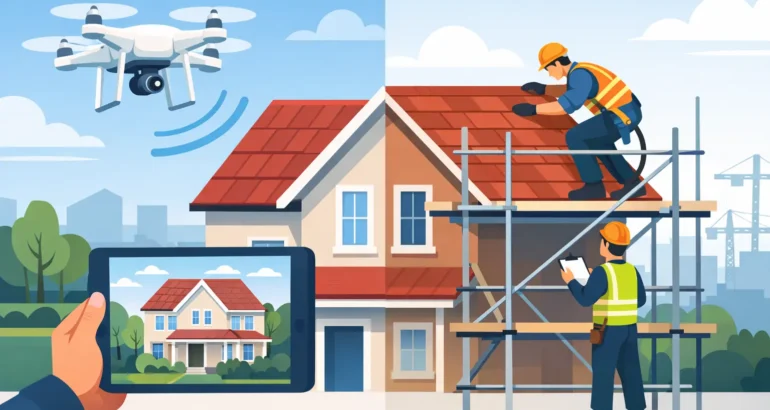
A roof defect can be difficult to challenge when the evidence is limited to a view from ground level. In a drone roof inspection vs scaffold decision, the best option is not always the one that gets closest to the roof. It is the method that gives you safe, clear and credible evidence for the condition you need assessed.
For new-build homeowners, warranty-period owners and commercial property managers, the question often arises after a visible concern: slipped tiles, uneven ridge lines, defective flashing, staining below a roof junction, suspected gutter issues or concerns about workmanship. Each access method has a place. The right choice depends on the roof design, the suspected defect, the required level of detail and whether remedial work is likely to follow.
Drone roof inspection vs scaffold: the practical difference
A drone survey uses high-resolution aerial imagery and video to inspect roof coverings, chimney stacks, valleys, gutters, verges and other elevated areas without putting a surveyor onto the roof. It is a rapid way to obtain a broad visual record of areas that may otherwise be inaccessible or expensive to reach.
Scaffolding is a temporary access structure that allows a person to work at roof level. It is normally installed to support repairs, replacement works or close physical investigation. While it can provide a surveyor or contractor with direct access, it takes longer to arrange, changes the appearance and use of the property while in place, and can be a significant cost where only an inspection is required.
Neither approach automatically produces a better result. A drone can reveal widespread workmanship concerns across an entire roof elevation in a single inspection. Scaffolding can allow close examination of a specific junction where a visual image alone cannot establish the cause of water ingress.
When a drone inspection is the sensible first step
For many domestic roof condition surveys, drone imaging is the proportionate starting point. It allows the surveyor to examine the roof from multiple angles and identify issues that cannot be properly assessed from a driveway, pavement or neighbouring land.
This is particularly useful on new-build properties where the concern is workmanship rather than immediate failure. Drone imagery may identify uneven tile courses, poorly finished verges, displaced tiles, incomplete ridge detailing, defective leadwork, damaged gutters or debris left following construction. The resulting images can be incorporated into an evidence-led report, helping the homeowner present clear findings to a developer or warranty provider.
A drone survey is also valuable where the roof is steep, high, fragile or positioned above a conservatory, extension or difficult boundary. Avoiding unnecessary access reduces risk and can prevent accidental damage to roof coverings. It also avoids the disruption of having scaffold erected around a home that is otherwise occupied.
Speed matters when a defect needs documenting before it worsens. Subject to weather conditions, airspace considerations and safe take-off and landing arrangements, a drone inspection can often be completed far more quickly than organising scaffold. This can be useful before the end of a builder warranty period, after severe weather or when preparing evidence for a contractor.
A professional drone inspection should not simply produce a folder of photographs. The value lies in interpretation. Images need to be assessed alongside roof design, visible workmanship, likely water paths and the wider condition of the building. A clear report should distinguish between an observed defect, a potential concern and an area that requires further investigation.
What a drone cannot confirm
Drone imagery has limits. It is a visual inspection method, not a substitute for every form of close inspection. It cannot test whether a tile is securely fixed, lift a tile to inspect the underlay, probe decayed timber or confirm the condition of concealed roof components.
It may also be difficult to inspect areas hidden by parapets, overhanging trees, solar panels, adjacent buildings or complex roof geometry. Rain, high winds and poor light can restrict safe flight or image quality. A responsible surveyor will record these limitations rather than overstate what has been seen.
Where a drone identifies a defect but cannot determine its full extent, the next step may be targeted access. That could involve a roofer using suitable equipment, a localised tower scaffold, or full scaffolding where repairs demand it.
When scaffolding is justified
Scaffolding is generally the better choice when physical access is essential. If there is an active leak around flashing, a suspected failure at a roof-to-wall junction, loose masonry at chimney level or damage requiring immediate repair, a contractor needs a safe working platform to investigate and undertake the work properly.
It is also appropriate where the proposed scope includes significant replacement or remedial works. Replacing roof tiles, renewing flashing, repairing a chimney, clearing extensive gutter defects or addressing recurring water ingress cannot be completed from drone images. Scaffold provides the stable access needed for workmanship, materials handling and supervision.
For an independent inspection alone, however, scaffold can be disproportionate. It may involve permits, neighbour considerations, installation lead times and the risk of access equipment itself causing disturbance to landscaping, driveways or roof edges. Its cost is usually difficult to justify if the purpose is simply to establish whether visible defects exist.
There is another practical point: being close to a roof does not necessarily mean seeing the whole roof well. A scaffold platform gives excellent detail at one elevation, but it may not provide the complete overhead view needed to identify inconsistent tile lines, valley defects or widespread finish issues on other slopes. In some cases, the strongest assessment uses drone imagery first, followed by physical access only where the findings support it.
Cost, safety and disruption
A drone roof inspection is usually the more cost-effective and less disruptive option for an initial condition assessment. There is no prolonged installation period, no structure surrounding the property and no requirement for a person to walk on the roof. It can provide extensive visual coverage while keeping occupants, neighbours and surveyors away from work-at-height hazards.
Scaffold costs vary considerably with height, access, roof shape, public highway requirements and duration. It may be a necessary investment for repairs, but it should not be treated as the default method simply because a roof is difficult to see from ground level.
Safety remains central to both methods. Drone operations must be planned and carried out lawfully, with appropriate checks for location, weather, people nearby and safe operating conditions. Scaffold must be designed, installed and inspected by competent professionals. The safer method is the one that matches the task, rather than the one that appears most familiar.
Choosing the right evidence for a developer or warranty claim
If you are raising concerns with a developer, a warranty provider or a contractor, evidence needs to be specific. A general statement that the roof “does not look right” is unlikely to achieve a prompt response. A structured inspection report with dated images, defect locations, observations and recommended actions gives your concerns greater weight.
For new-build homes, drone imagery can be especially effective in documenting visible workmanship issues before they become obscured by later alterations or disputed after handover. It can show the relationship between roof defects and external elevations, gutters, drainage points or visible internal staining.
That said, reports should avoid diagnosing hidden causes without sufficient evidence. If the image indicates an open joint or defective flashing detail, the report should explain what is visible, why it may affect performance and whether closer investigation is recommended. This is more credible than presenting an assumption as fact.
An independent surveyor can help determine whether the issue appears to be a snagging matter, a maintenance issue, a potential warranty concern or a defect that requires urgent contractor attention. At New Homes Inspections, the focus is on clear, evidence-backed findings that help property owners seek practical remedial action.
A proportionate route to roof inspection
For a high-level visual assessment, suspected construction defects, post-storm checks or warranty evidence, start with a professional drone inspection. It offers broad coverage, detailed imagery and a safer route to establishing whether a concern needs escalating.
Choose scaffolding when the findings point to a defect that needs hands-on investigation or repair, or when access is required for work rather than observation. In some cases, a drone survey will save the cost of unnecessary scaffold. In others, it will provide the evidence needed to specify exactly where scaffold access is required.
Before approving costly access arrangements, ask what question needs answering: do you need to see the roof clearly, or does someone need to work on it? That distinction can protect your investment, reduce disruption and lead to a more focused remedy.